The History of Women's Mosques in Chinese Islam by Jaschok Maria & Shui Shui Jingjun
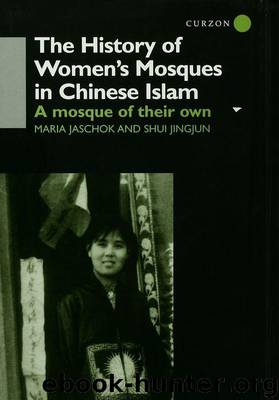
Author:Jaschok, Maria & Shui, Shui Jingjun [Jaschok, Maria]
Language: eng
Format: azw3
Publisher: Taylor and Francis
Published: 2013-10-10T16:00:00+00:00
PLATE 7: Yang Yinlian Ahong with her congregation on zhuma, Eastern Mosque, Harbin. 18 April 1997 (Jaschok)
Phenomenologically understood, lived time, as Ma Ahong from a Kaifeng women’s mosque put it, is a state of pious waiting for that which God has already willed to happen. The past is contained in the pages of the Koran, evoked daily to endure the ever-anticipated future and imagined with much trepidation (see Chapter X). In the construction of gendered historical consciousness, it is necessary to be aware of the presence of pivotal belief among these Muslim women of a non-negotiable causality between the past, which contains the blueprint of the divine will, and the future, predetermined in its prospect of eternal life in paradise or hell.
Feminist scholarship has paid scant attention to women’s perceptions of the past. In a rare but brief treatment of women’s historical consciousness, Fentress & Wickham (1992) argue that it is possible to situate it as distinct in type from men’s consciousness. Narratives reveal relatively little group consciousness as women’s role in society commonly precluded the emergence of a collective identity; this in turn has made public celebrations and commemorations the domain of men. Even the style of narration has been appropriated by men which is appropriate more for the commemoration of (male) public activities rather than female experience. Male official discourse drowns out a textuality which could reveal other kinds of testimonials (Fentress & Wickham, 1992:137–140).
Patterns in West European women’s narratives of the past are summarised by Fentress and Wickham as related only peripherally to public events, reflecting their inferior status in society; as recollecting common public events in terms of ‘everyday aspects’ and ‘small-scale’ activities, thus different in substance from men’s recollections; and also as tending toward more precise and accurate, often irreverent, accounts of the minutiae of domestic and emotional events which involve relationships. ‘For the women, memory was of ongoing experience, rather than of personal choice’ (Ibid: 142). Where choice is involved, men and women remember differently. Men are more likely to emphasise achievement and attainments whereas women are likely to reflect on powerlessness and personal cost such as additional burden, fatigue, under-recognition. Fentress and Wickham thus found that similar experiences could make for ‘social memories that were genuinely divergent in type’ (1992:143, italics in text). Their findings tell us that factuality, orderliness, chronology, that is, the methodology of ‘objective’ history (Le Goff, 1992), sit uneasily on the historical consciousness of women. When we therefore locate women’s memory, understood as subjective and ‘inscriptive’ (Gillis, 1994:4) rather than descriptive, within the objective history transmission, we must remind ourselves of their vulnerability to personal and repressive power politics.
How can gendered memory be situated within a collective historical narrative that tells of (Hui) minority identity in the Chinese state? Within this specific context of authoritarian appropriation of the transmissions and transmitters of ‘correct’ history, non-official versions become ‘secret’ or ‘oppositional’ (see R. Watson, 1994, on relationship between memory and history), transmitted solely in inner circles or given out on carefully judged occasions to outsiders (i.
Download
This site does not store any files on its server. We only index and link to content provided by other sites. Please contact the content providers to delete copyright contents if any and email us, we'll remove relevant links or contents immediately.
Plagued by Fire by Paul Hendrickson(17542)
The 5 Love Languages: The Secret to Love That Lasts by Gary Chapman(10016)
How to Bang a Billionaire by Alexis Hall(8278)
Wonder by R. J. Palacio(8245)
The Institute by Stephen King(7165)
The Testaments by Margaret Atwood(7113)
The Thirst by Nesbo Jo(7111)
The Space Between by Michelle L. Teichman(7041)
Assassin’s Fate by Robin Hobb(6376)
Wiseguy by Nicholas Pileggi(5945)
Spare by Prince Harry The Duke of Sussex(5374)
The Night Circus by Erin Morgenstern(5355)
The MacArthur Bible Commentary by John MacArthur(4968)
Bittersweet (True North #1) by Sarina Bowen(4926)
Tuesdays with Morrie by Mitch Albom(4917)
Everything Happens for a Reason by Kate Bowler(4846)
Gerald's Game by Stephen King(4806)
The Templars by Dan Jones(4806)
From Sand and Ash by Amy Harmon(4680)
